معيار كيلي والروليت
معيار كيلي بيوري المراهن العندو ميزة يراهن بقدر شنو. وفي الروليت بيدّي إجابة واضحة: ولا حاجة.

مبلغ كيلي = الميزة / نسبة الدفع. ولو الميزة سالبة الصيغة بتطلّع نسبة سالبة، ومعناها: ما تراهن. ومع كدا المعيار مفيد عشان تفهم ليه لاعبين الانحياز حددوا رهاناتهم بالطريقة دي، وليه أي زول تاني لازم يحدد رهانو حسب الميزانية.
المعيار
John Kelly (1956) asked how a gambler with a known edge should size bets to maximize long-run growth of the bankrollالمالرأس مال اللعبالمبلغ كلو الشلتو على جنب للعب. وإدارة رأس المال إنك تقرّر قدّر شنو منو حتخاطر بيهو في كل رهان وفي كل جلسة.اقرا الكلام كلّو ←. The answer, for a bet paying b to 1 with win probabilityرياضياتالاحتمالفرصة إنو نتيجة تحصل، من 0 لحدّي 1 أو من 0% لحدّي 100%. رقم واحد: 1/37 = 2.70%.اقرا الكلام كلّو ← p and loss probability q = 1 − p, is to stake the fraction f* = (bp − q) / b of the bankroll. Positive f* means bet that fraction; zero or negative means do not bet. Kelly worked at Bell Labs, and his paper, “A new interpretation of information rate”, set the problem in Claude Shannon’s theory of information: a gambler who gets tips over a noisy line, at fair odds, can grow the bankroll at best at the rate the line carries information. This is a growth objective under a probability model, not a promise to finish ahead after a particular number of bets. A spending limit, finite deadline or payoutالمالالدفعالبيرجّعو الرهان الكسبان، وبيقولوهو بصيغة «X مقابل 1» فوق مبلغ الرهان البيرجع.اقرا الكلام كلّو ← cap changes the decision problem.
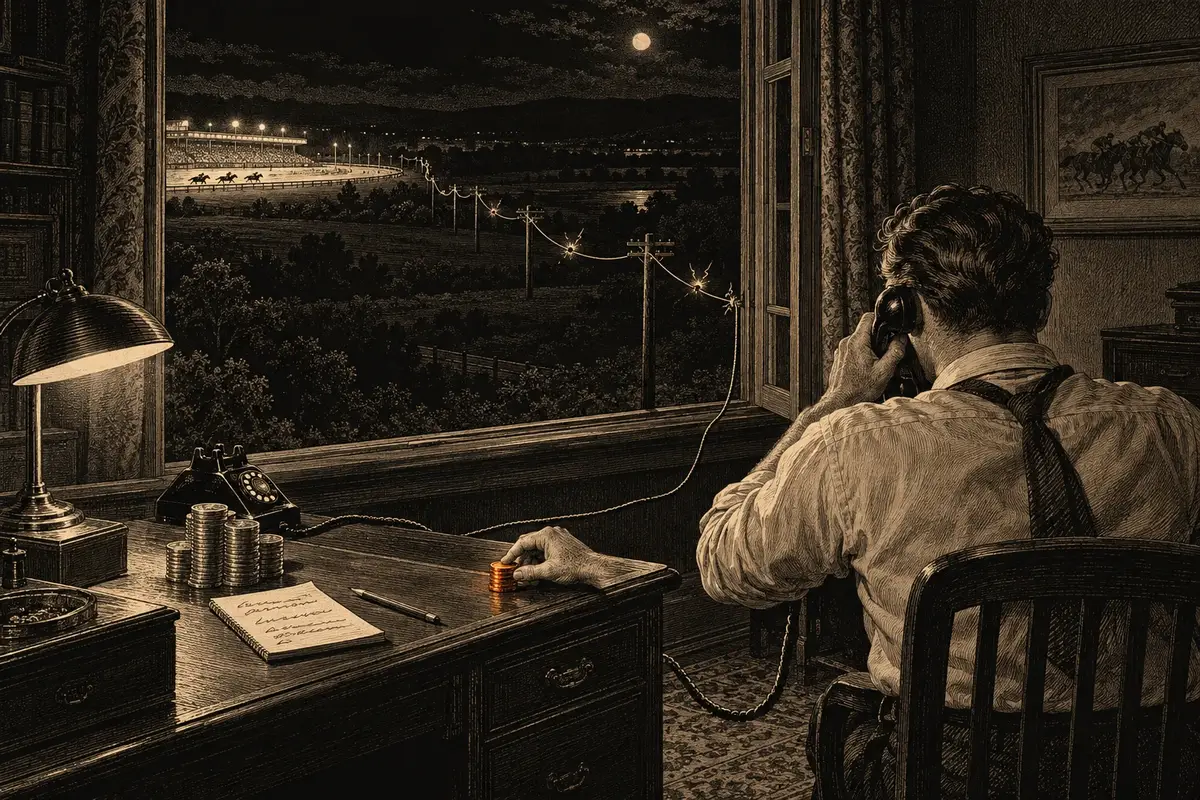
رهان كيلي في الروليت
For redرهانالأحمررهان دفع متساوي على الـ18 رقم الأحمر. بالفرنسي: rouge.اقرا الكلام كلّو ←: b = 1, p = 18/37, q = 19/37; f* = (18/37 − 19/37)/1 = −1/37. For a straight upرهانرهان الرقم الواحدرقم واحد، بيدفع 35:1.اقرا الكلام كلّو ←: b = 35, p = 1/37, q = 36/37; f* = (35/37 − 36/37)/35 = −1/1295. Every standard bet gives a negative Kelly fraction, because every bet has a negative edge, and the growth-optimal stake is zero. Kelly betting on roulette is a formal way of saying what the house-edge page says: no positive stake maximizes expected logarithmic growth when the bet has negative expectation. A particular session can still end in profit. La partageقاعدةLa Partageقاعدة فرنسية: لمن الصفر يطلع، نص مبلغ رهان الدفع المتساوي بيرجع ليك. بتنزّل أفضلية الكازينو في الرهانات دي للنص، يعني 1.35%.اقرا الكلام كلّو ← needs a separate three-outcome calculation: a win, a full loss or a half-loss on zeroالعجلةالصفرالخانة الخضراء الوحيدة الما بيغطّيها أي رهان دفع متساوي أو دزينة أو عمود؛ مصدر أفضلية الكازينو. وبيسمّوهو برضو: الصفر الواحد، 0.اقرا الكلام كلّو ←. Its expected log growth also falls as the stake increases from zero.
وين كيلي اتطبّق بجد
Suppose a pocketالمعداتالخانةواحدة من الـ37 خانة المرقّمة في الدوّار. وبيسمّوها برضو: الفتحة، الكأس.اقرا الكلام كلّو ← really has a stable, known probability of 1 in 30 and pays 35 to 1. The Kelly fraction is 0.57%: about $57 from a $10,000 bankroll. Under independent spinsرياضياتالدورات المستقلةكل دورة عندها نفس الاحتمالات مهما كان الحصل قبلها. وده أساس كل حساب في الموقع ده.اقرا الكلام كلّو ← and exact fractional staking, the geometric growth factor over 1,000 spins is about 1.7. Expected bankroll grows faster because rare large wins pull up the average. These are model calculations, not evidence that any named historical player used Kelly or achieved this result.
النموذجي والمتوسط
The gap between the typical bankroll and the average one is wide. Take a pocket that hits 1 time in 25, a hypothetical edge of 44% per unitالمالالوحدةمبلغ الرهان الأساسي البيشتغل بيهو النظام أو اللاعب. التدرّجات بيوصفوها بالوحدات عشان تنفع في أي طاولة.اقرا الكلام كلّو ← staked. Kelly stakes 1.26% of the bankroll on it. After 1,000 spins the typical bankroll has grown about 11.5 times, while the average, pulled up by a few very lucky runs, has grown about 249 times. Betting more than Kelly raises the average and lowers the typical result: at twice the Kelly stake the typical bankroll only doubles, and by two and a half times the Kelly stake it shrinks, although every bet still carries a 44% edge. In this example, half-Kelly retains about 78% of the expected log growth. This fraction depends on the probabilities and payout.
لمن الميزة تكون تخمين
Kelly uses the true probabilities, but a player usually has only estimates. Selecting the busiest pocket from a past record creates a selection problem: even a fair wheel has a busiest pocket. Its observed rate can overstate its future probability. Choosing the stake from that same record compounds the error. An independent follow-up sample helps test a proposed bias (see How to Detect Roulette Wheel Bias). Reducing the calculated fraction reduces exposure, but cannot turn a false edge into a real one.
ناس عندهم ميزة
Haghani and Dewey (2016) studied 61 participants given $25 and 30 minutes to bet on a simulated coin with a disclosed 60% chance of heads. The payout cap was $250; its value was revealed when a proposed winning bet would reach it. Their reported 21% success category included balances of at least $200, while the 28% “bust” category meant less than $2, not necessarily zero. Eighteen participants bet their entire balance on one flip. The uncapped Kelly fraction is 20%, but the cap and deadline change the optimization problem. The experiment illustrates how stake choices matter even with a known advantage; it does not establish one best strategy for every objective.
تستعمل شنو بدلو
بدون ميزة، تحديد المبلغ مسألة ميزانية ما مسألة نمو: مبلغ الرهان = القدر الإنت مستعد تصرفو في كل دورة، طالع من ميزانية الساعة وسرعة الطاولة (صفحة إدارة رأس المال). الحاجة البيقدّمها كيلي للاعب العادي هي وضوح إجابتو: صفر. وأي حاجة بتراهن بيها فوق الصفر هي تمن اللعب، إنت البتختارو، وما في صيغة بتحسّنو.
ملاحظة عن كيلي الجزئي و«إدارة القروش»
Betting a fixed percentage of the current bankroll is proportional staking: the stake rises after wins and falls after losses. Flat bettingاستراتيجيةالرهان الثابتإنك تراهن بنفس المبلغ في كل دورة. وده الأساس البيقارنوا بيهو أي تدرّج.اقرا الكلام كلّو ← instead keeps the cash stake fixed. Neither creates an edge on ordinary roulette. With infinitely divisible stakes and a fraction below 100%, proportional staking never reaches exactly zero in finitely many losses, but the balance can become arbitrarily small. Real table minimums can prevent further play much sooner. The growth-optimal fraction remains zero.
الصيغة
أسئلة
Only when the actual probabilities, payouts and conditions give a credible positive advantage. Standard bets on an unbiased wheel have no such advantage.
Using half the calculated fraction reduces exposure to errors in the estimated edge. The familiar three-quarters-growth rule is an approximation for small advantages, not a universal identity. It does not protect against an edge that does not exist.
لا. كيلي بيحسّن النمو لمن تكون في ميزة. وإدارة رأس المال بتضبط الصرف لمن ما تكون في ميزة.
متعة الرياضيات
جرّب تحلّها براك أول. كل حل مطوي؛ افتحو لمّن تكون جاهز.
Suppose a hypothetical bet on one number has a known 44% edge under standard payoutsالمالالدفعالبيرجّعو الرهان الكسبان، وبيقولوهو بصيغة «X مقابل 1» فوق مبلغ الرهان البيرجع.اقرا الكلام كلّو ← and independent spinsرياضياتالدورات المستقلةكل دورة عندها نفس الاحتمالات مهما كان الحصل قبلها. وده أساس كل حساب في الموقع ده.اقرا الكلام كلّو ←. Kelly gives a 1.26% bankrollالمالرأس مال اللعبالمبلغ كلو الشلتو على جنب للعب. وإدارة رأس المال إنك تقرّر قدّر شنو منو حتخاطر بيهو في كل رهان وفي كل جلسة.اقرا الكلام كلّو ← fraction. What if the same 44% edge came on one bet spread over five neighboring numbers?
عرض الحل
الإجابة وقتها معيار كيلي بيقول 7.1% من رأس المال، ورأس المال بيكبر أسرع بحوالي ستة مرات: حوالي 1.25 مليون ضعف خلال 1,000 رهان، مقابل حوالي 11.5 ضعف.
A straight upرهانرهان الرقم الواحدرقم واحد، بيدفع 35:1.اقرا الكلام كلّو ← with a 44% edge wins with chance 0.04, since 36 × 0.04 = 1.44. Kelly’s stake is the edge divided by the odds: 0.44/35 = 1.26%. The typical growth per bet is 0.04 × ln(1 + 35 × 0.0126) + 0.96 × ln(1 − 0.0126) ≈ 0.00244, so 1,000 bets multiply the bankroll by about e^2.44 ≈ 11.5.
Spread one stake over five numbers and the bet wins with chance 0.20 and pays 36/5 for 1, that is 6.2 to 1: still a 44% edge, since 0.2 × 7.2 = 1.44. Kelly’s stake becomes 0.44/6.2 = 7.10%, and the growth per bet 0.01404, about 5.75 times as much. Over 1,000 bets that is e^14.04, about 1.25 million.
The edge is the same; the swings are smaller. A bet that wins one time in five has a larger growth-optimal fraction in this model, although losses can still reduce the bankroll severely. This comparison assumes the same known edge for both bets; actual predictions need independent evidence.
Assume two numbers are adjacent on the betting layoutالمعداتلوحة الرهانشبكة الرهان المطبوعة في الطاولة. وبيسمّوها برضو: الطاولة، الجوخ، القماش.اقرا الكلام كلّو ← and each has a stable, known probabilityرياضياتالاحتمالفرصة إنو نتيجة تحصل، من 0 لحدّي 1 أو من 0% لحدّي 100%. رقم واحد: 1/37 = 2.70%.اقرا الكلام كلّو ← of 1 in 25 on independent spins. Compare a splitرهانرهان الرقمينرقمين جنب بعض، بيدفع 17:1.اقرا الكلام كلّو ← between them at 17 to 1 with equal straight-up stakes on the two numbers. How much does Kelly say, and how fast does the bankroll grow compared with one such pocketالمعداتالخانةواحدة من الـ37 خانة المرقّمة في الدوّار. وبيسمّوها برضو: الفتحة، الكأس.اقرا الكلام كلّو ←?
عرض الحل
الإجابة ما في فرق: 2.59% من رأس المال على رهان الرقمين، أو 1.29% على كل رقم. ورأس المال النموذجي بيكبر حوالي 155 مرة في 1,000 دورة، مقابل 11.5 مرة مع خانة واحدة.
The split wins with probability 2/25 = 0.08 and pays 17 to 1, so it returns 18 × 0.08 = 1.44 per unitالمالالوحدةمبلغ الرهان الأساسي البيشتغل بيهو النظام أو اللاعب. التدرّجات بيوصفوها بالوحدات عشان تنفع في أي طاولة.اقرا الكلام كلّو ← staked: an edge of 44%, the same as one biased pocket. Kelly’s stake is the edge divided by the odds: 0.44/17 = 2.59%.
Two straight-up bets of 1.29% each give exactly the same results. When either number comes up, one chipالمالالفيشةقطعة بتمثّل مبلغ ثابت، بتختّها في لوحة الرهان عشان تعمل رهان. وبيسمّوها برضو: check.اقرا الكلام كلّو ← wins 35 to 1 and the other is lost, a net of 34 × 1.29% = 44% of the bankroll, as the split pays; when neither does, both are lost.
The growth per spin is 0.00505, against 0.00244 for one pocket, so over 1,000 spins the typical bankroll grows e^5.046 ≈ 155 times rather than e^2.44 ≈ 11.5 times. The geometric growth factor is larger because the combined bet wins more often at the same 44% edge. It is a model result, not a guaranteed bankroll.
استراحة ضحك
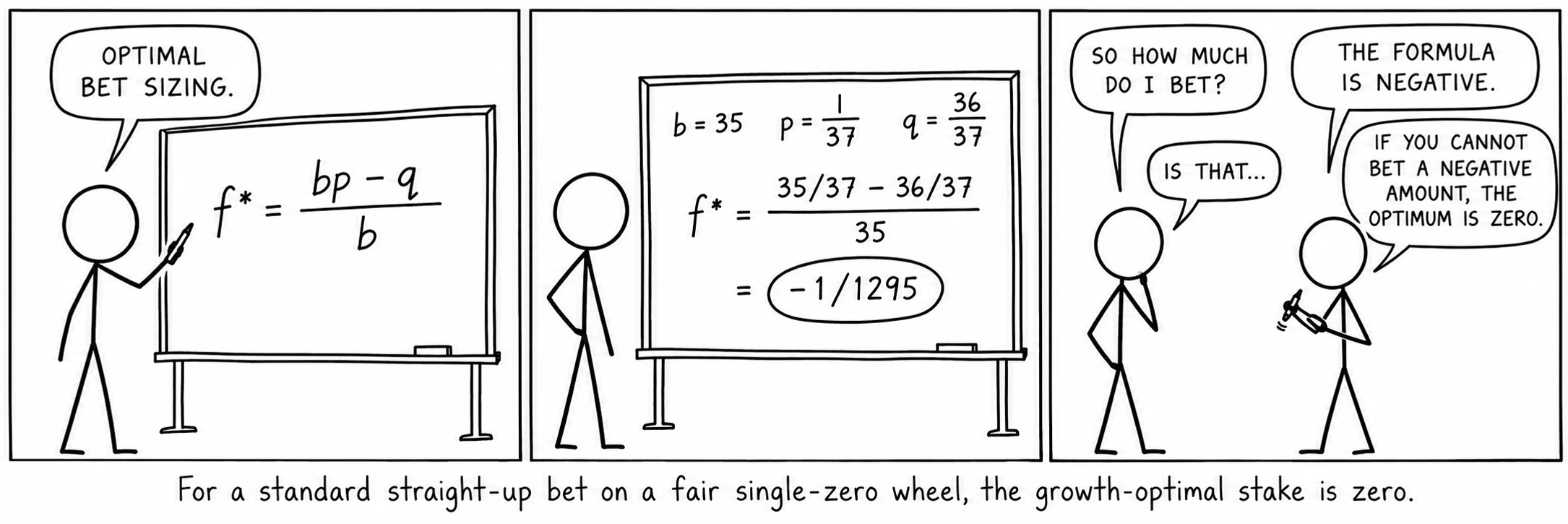
المبلغ الأمثل للنمو في الروليت رقم كلنا عارفنو من زمان.
المصادر
- Kelly, J. L. “A new interpretation of information rate.”
- Breiman, L. “Optimal gambling systems for favorable games.”
- Thorp, E. O. “Optimal gambling systems for favorable games.”
- Thorp, E. O. The Mathematics of Gambling.
- Epstein, R. A. The Theory of Gambling and Statistical Logic, 2nd ed.
- Taylor, D. G. Games, Gambling, and Probability: An Introduction to Mathematics, 2nd ed.
- Ethier, S. N. The Doctrine of Chances: Probabilistic Aspects of Gambling.
- Haghani, V. & Dewey, R. “Rational decision-making under uncertainty: observed betting patterns on a biased coin.”